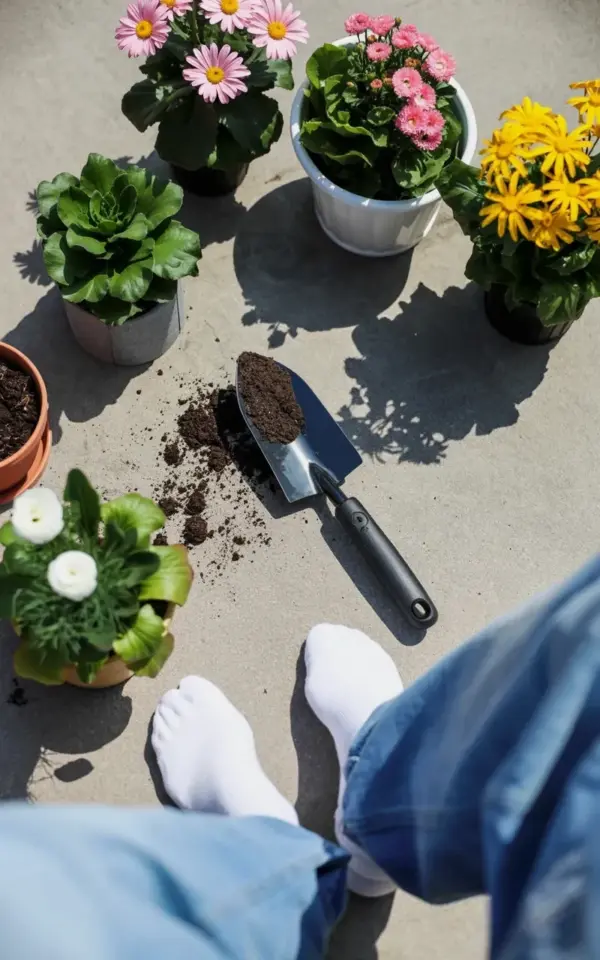
There’s a moment during repotting flowers when the whole patio goes quiet and you just start scooping soil. That’s exactly what happened here, top-down view: a black-handled trowel with old soil crusted on the grip, pink and yellow daisies still in their white pots, a few green leafy plants in gray containers, and my own blue jeans and white socks at the bottom of the frame. The shadows were getting sharp, which meant the sun was doing its thing. I had maybe fifteen minutes before I needed to be anywhere else, so I made the call to move everything right there on the light gray concrete.
Most people overthink this. They read a hundred articles about root systems and drainage holes, then end up doing nothing because they’re scared of killing the plant. Honestly, the only real disaster is leaving a root-bound plant in a too-small pot for another season. So let me walk you through the mistakes I see all the time in container gardening, and the quick fixes that actually work.
The container gardening mistake nobody talks about: waiting until the plant is dying
I’ve done it. You get a nice potted daisy, it blooms, you’re happy, and then you forget that the pot is now a cramped little prison. By the time the leaves start yellowing or the flowers shrivel, the plant has already spent weeks in survival mode. The fix is embarrassingly simple: check your containers every few weeks, especially after heavy rain or a growth spurt that pushes roots out of the drainage holes.
Here’s the sign I look for. If the soil dries out within a day after watering, that’s not a plant being thirsty. That’s a root mass taking up so much space that water just runs through. That’s your cue to act. Not next week. Now.
How to tell if your potted daisies need a bigger pot before it’s obvious
You don’t need to yank the plant out and inspect a giant root ball. Just lift the pot. Seriously, pick it up. A pot that’s full of roots is noticeably heavier than it should be, even when the soil is dry. Another trick: look at the top of the soil surface. If you see a web of thin roots crowding the edges, that’s the plant saying “I’m done here.”
With my pink and yellow daisies, the white pots were almost comically small compared to the foliage. The roots were growing out of the bottom like they were trying to escape. You don’t need to be an expert to notice that. You just need to look at the underside of the pot once in a while.
And if you’re unsure, just do it. Repotting a plant that didn’t strictly need it is way less damaging than leaving it root-bound for months.
A quick repotting flowers rule: use the right soil, not whatever is left in the bag
This is where I see people mess up container gardening more than anywhere else. They grab garden soil from a flowerbed, dump it into a pot, and wonder why their potted daisies are suffocating. Garden soil is too dense for a container. It compacts, holds water, and turns into a brick that roots can’t push through. You need a potting mix, which is lighter and designed for confined spaces.
I used regular grocery store potting mix for this whole job. Nothing fancy. It had a bit of slow-release fertilizer mixed in, which is nice because I didn’t have to remember to feed the flowers for another month. That’s my kind of lazy.
Patio gardening with nothing but a trowel and a sunny spot
You don’t need a potting bench, a kneeler pad, or fancy ergonomic tools. In the photo, you can see me working directly on the concrete, with a black-handled trowel doing all the heavy lifting. The best part about patio gardening is that it happens wherever you are. Your deck, your balcony, even a sunny corner of a parking lot. The flowers don’t care about the background.
Here’s the quick method I used:
- Fill the new pot about a third full with fresh potting mix, then compact it lightly with your fingers.
- Turn the old pot sideways, grip the base of the plant with one hand, and pull the pot off with the other. If it’s stubborn, squeeze the sides of the plastic pot a few times.
- Set the root ball in the center and scoop soil around it, pressing down gently as you go. Leave about an inch of space between the soil and the rim.
That’s the whole procedure. It took me less than ten minutes per pot. And I didn’t even have to water immediately afterward because the soil was already moist enough. People act like this is surgery, but it’s really just moving a plant from a small home to a bigger one.
The one gardening tip that sounds backwards: water before you repot, not after
Every beginner guide says to give your newly repotted plant a big drink. I’m going to tell you to skip that. Watering right after repotting can actually settle the soil too hard, turning it into a dense mess that doesn’t drain. Instead, water the plant thoroughly a few hours before you repot it. Then, when you move it, the root ball stays together and the soil is already hydrated.
After you’ve tucked in the roots and put the plant back in a bright spot, wait a day before watering. The plant will be fine. It’s not as delicate as the internet makes you think. I’ve forgotten to water a newly potted daisy for two days and it bounced back better than the ones I babied.
What to do with the empty pots and leftover soil (a real patio gardening problem)
Here’s a silly thing that happens: you repot all your flowers and suddenly you have a stack of old plastic pots and a half-empty soil bag sitting on the patio. It looks messy and it will eventually get rained on and turn into a soggy mess. My tip is to have a designated place for this stuff. A garage shelf, a corner behind the barbecue, anything. Otherwise, your patio looks like a recycling bin that exploded.
I’m not saying this to be neat. I’m saying it because old pots left outside become mosquito breeding grounds when they collect rainwater. That’s not a gardening tip, that’s a public health announcement. I speak from sad, itchy experience.
After the repot: avoid this common mistake with potted daisies
You’ve moved your flowers. You’ve used the right soil. Now the biggest mistake is placing them right back where they were without thinking about the sun. A bigger pot means the soil stays moist longer, which means the roots stay cooler. That’s good. But it also means the plant might now get too much direct afternoon sun if the old pot dried out faster. Watch your flowers for a few days. If the petals look bleached or the leaves droop at midday, shift the pot a few feet.
In my case, the pink and yellow daisies ended up in a spot that gets morning sun and afternoon shade. The shadows in the photo were already starting to lengthen, so I knew the intense heat was coming. That little bit of planning made all the difference.
Repotting flowers doesn’t have to be a weekend project. I did all of this in the time it takes to watch a short sitcom episode, and I didn’t even have to change out of my jeans and socks. Next time your container garden feels off, just pick up the pot, look at the roots, and trust that you can figure it out on the concrete with a trowel and plain old potting soil.
Save this one for your next repotting day, and if you try it, tell me how the daisies look. I’m always curious what works for other people’s patios.
Leave a Comment